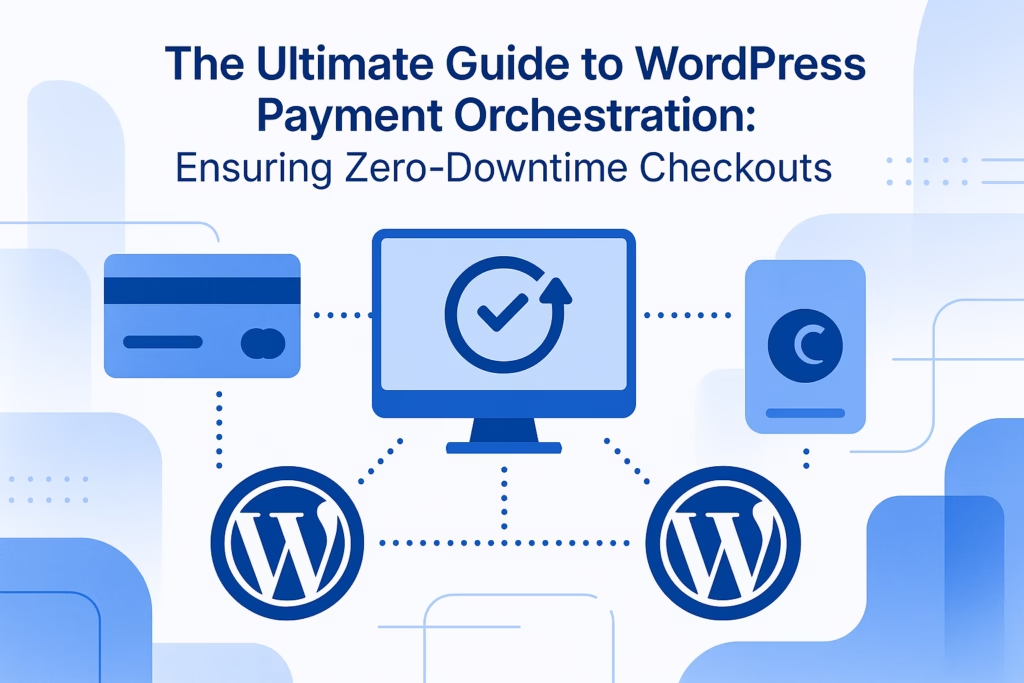
The Single Point of Failure in Modern WordPress Commerce
For high-volume WooCommerce merchants, relying exclusively on a monolithic payment gateway—such as Stripe or PayPal—is a strategic vulnerability. While these providers dominate Tier-1 markets (US, UK, EU), their authorization rates plummet when processing cross-border transactions in emerging markets like LATAM, APAC, and MEA. Data indicates that false declines and lack of local Alternative Payment Methods (APMs) can cost global merchants up to 30% of their potential revenue.
This article details the architectural shift from static payment processing to dynamic WordPress payment orchestration. We will explore how to implement intelligent routing, ensure redundancy, and leverage localized infrastructure without establishing legal entities in every target jurisdiction.
Deconstructing Payment Orchestration for WordPress
Payment orchestration is not merely adding more gateways; it is the implementation of a logic layer between your WordPress checkout and the banking networks. Instead of a hard-coded connection to a single processor, an orchestration layer (like WPAYO) acts as a traffic controller.
The Technical Mechanism: Cascading and Smart Routing
In a standard WordPress setup using a single gateway plugin, a transaction follows a linear path: Checkout > Gateway API > Acquiring Bank. If the bank rejects the transaction (due to cross-border fraud flags or currency mismatches), the sale is lost.
With an orchestration layer, the workflow changes:
- BIN-Based Routing: The system identifies the card issuing country via the Bank Identification Number (BIN) and routes the transaction to a local acquirer within that region, significantly boosting acceptance rates.
- Cascading Logic: If the primary processor returns a soft decline (e.g., “Do Not Honor”), the engine automatically retries the transaction through a secondary provider transparently to the user.
- APM Injection: The checkout dynamic renders local payment methods (Pix in Brazil, UPI in India, OXXO in Mexico) based on the user’s IP and shipping address.
The Gap in Monolithic Gateways (Stripe/PayPal)
While Stripe is the default for many WordPress builds, its “one-size-fits-all” fraud logic is often too aggressive for non-Western markets. Furthermore, Stripe generally requires a local business entity to access local acquiring rates in countries like Brazil or India. Without this, merchants face cross-border fees (often 1-2% higher) and lower authorization rates due to the transaction being flagged as “foreign.”
Differentiation Strategy: WPAYO vs. The Giants
WPAYO addresses this specific competitive gap. Unlike generic aggregators, WPAYO utilizes an intelligent routing engine specifically optimized for high-risk and emerging market sectors. The core USP lies in Entity-Agnostic Local Processing.
- Monolithic Approach: Requires you to register a company in Mexico to process local MXN cards efficiently.
- WPAYO Orchestration: Provides a single-API integration that routes funds through existing local infrastructure, effectively bypassing the friction of local entity requirements while maintaining domestic authorization rates.
Implementation: Integrating Orchestration into WooCommerce
Transitioning to an orchestration model does not require rebuilding your stack. The goal is to replace the direct gateway connection with the orchestration middleware.
Step 1: The API Handoff
Instead of installing the Stripe for WooCommerce plugin, merchants install the WPAYO integration. This plugin hooks into the woocommerce_payment_gateways filter but does not process the card immediately. It tokenizes the credentials and passes them to the orchestration engine.
Step 2: Configuring Routing Rules
Within the WPAYO dashboard, merchants define logic rules without code:
IF Customer_Country == 'BR' (Brazil)
THEN DISPLAY 'Pix' AND 'Boleto'
AND ROUTE Card_Transactions -> Local_Brazil_Acquirer
ELSE IF Transaction_Value > $500
ROUTE -> High_Value_Processor (with 3DS)
Step 3: Handling Webhooks and IPNs
Because orchestration often involves asynchronous payment methods (like cash vouchers or crypto), standard synchronous API responses are insufficient. Your WordPress endpoint must be configured to handle delayed Webhook notifications to update order statuses from “Pending Payment” to “Processing” hours or days later, ensuring zero downtime in order fulfillment workflows.
The ROI of Redundancy
The ultimate goal of WordPress payment orchestration is zero-downtime revenue collection. By diversifying the backend processing while maintaining a unified frontend experience, merchants insulate themselves from processor outages and regional banking instability. For digital product sellers and high-volume dropshippers operating globally, WPAYO offers the technical infrastructure to turn 15% failure rates into recovered revenue.








Leave a Reply